Design & Handwerkskunst
Full Grain vs. Top Grain Leather: A Manufacturer's Guide to Yield Rates and Sourcing Costs
Veröffentlicht am 2. Nov. 2026
Executive Summary for Sourcing Managers When developing a custom leather goods program, choosing between Full Grain and Top Grain leather is rarely a debate about chemical composition—it is a strict calculation of manufacturing yield rates, scalability, and retail margins. For heritage and bespoke collections, Full Grain commands premium pricing but suffers from high cutting waste (yielding only 60%-70%). For scalable OEM mass production requiring perfect visual consistency, Top Grain delivers an 85%-90% yield. This factory-level guide breaks down the hidden costs, processing realities, and the critical role of human craftsmanship in your supply chain.
1. The Reality of Yield Rates (Cutting Loss)
The biggest hidden cost in leather goods sourcing is the yield rate (the percentage of the hide that actually makes it into your final product).
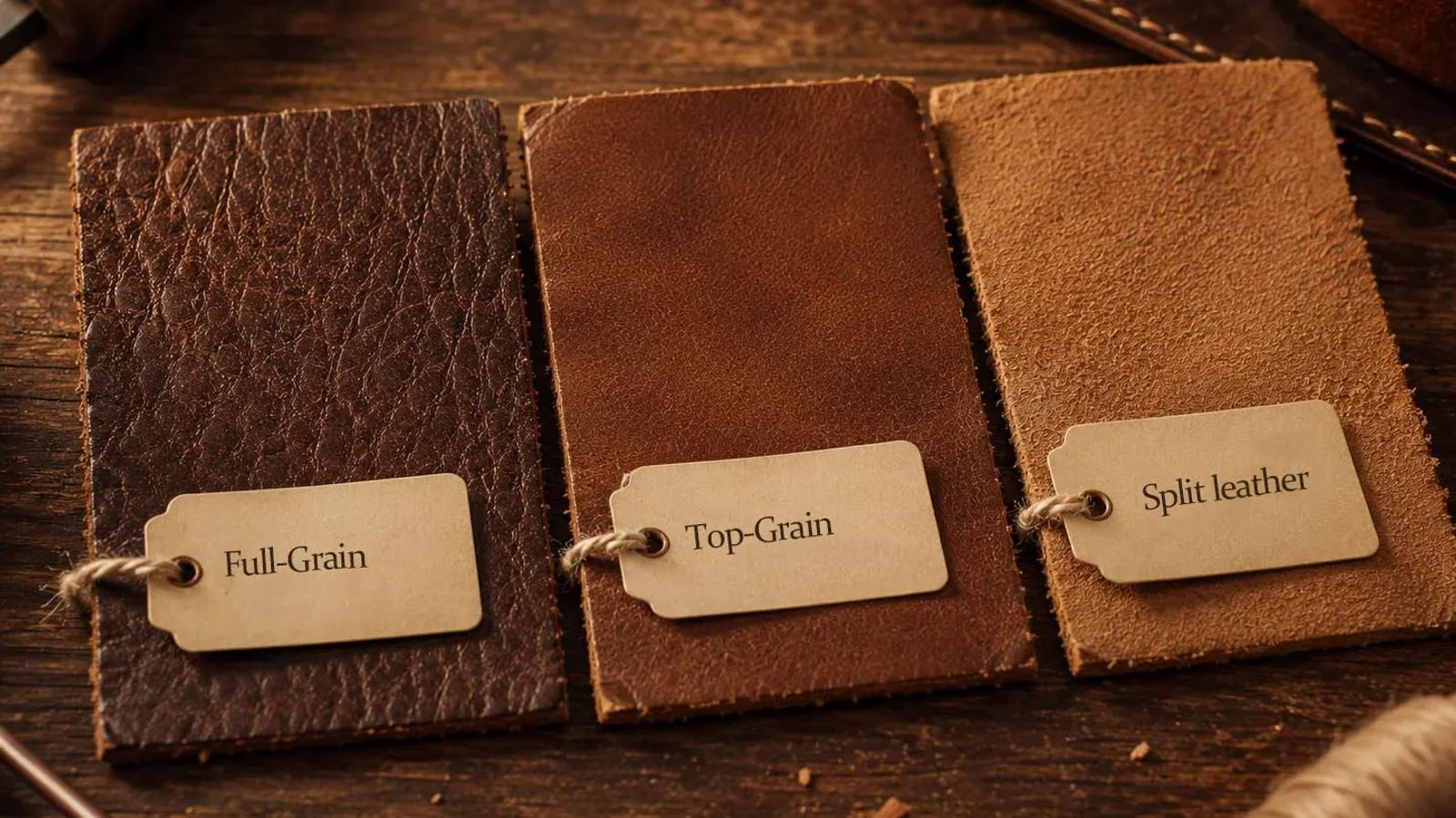
Full Grain Leather (Yield Rate: 60% - 70%) Full grain leather retains the exact epidermal surface of the cowhide. This means every natural hallmark is visible: insect bites, barbed wire scratches, stretch marks, and neck wrinkles.
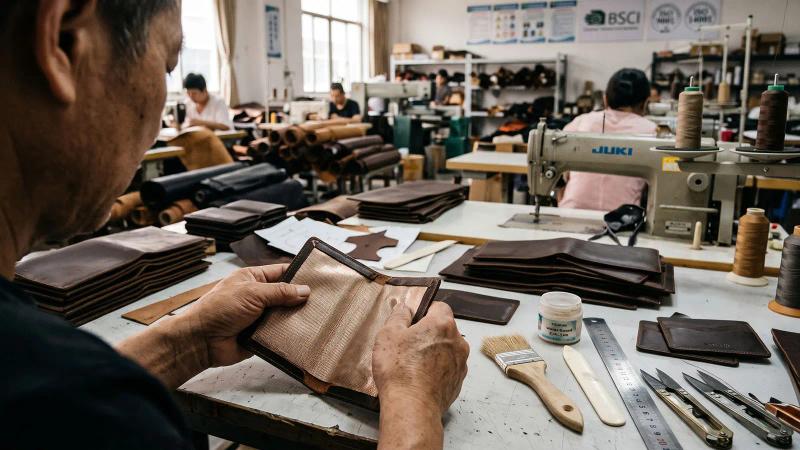
- The Cost Factor: On our clicking (cutting) floor, automated laser cutters often fail here. It requires a highly skilled human "clicker" to manually inspect every square inch of the hide, strategically placing cutting dies to avoid severe defects while capturing the best grain for the front panels of a wallet. This rigorous selection process results in 30% to 40% of the hide being discarded as scrap, drastically driving up the per-unit material cost. Those clickers are not subcontracted: they work on our own floor in the Baiyun District manufacturing base, Guangzhou, alongside a senior cutting and finishing team — the certifications, TUV-verified processes and 100% inspection behind that floor are set out on our about page.
Top Grain Leather (Yield Rate: 85% - 90%) For brands needing strict budget control and high volume, Top Grain is the undisputed choice.
- The Cost Factor: Because the surface flaws have been removed, the hide is remarkably uniform. Our cutting operators can maximize the layout with minimal waste, pushing the yield rate up to 90%. This material efficiency directly translates to a more competitive FOB price for your brand. If you are scaling that kind of programme, our OEM/ODM team runs it on the same floor: flexible MOQs, sampling back in 3 to 5 days, and 100% inspection before packing, so the yield saving survives all the way to your FOB.
2. Debunking the Myth: How Top Grain is Actually Processed
A common misconception among beginner buyers is that factories "cut out" the flawed parts of a hide to make Top Grain. This is entirely false.
In a modern tannery, if a hide has too many surface blemishes, it is sent through heavy industrial buffing machines. Abrasive sanding cylinders shave off the top 0.1mm to 0.2mm of the epidermis—just enough to erase the scars and bug bites.
Once sanded, the leather has a suede-like feel. To restore a premium finish, heated steel plates and hydraulic presses stamp an artificial grain (such as the famous Saffiano cross-hatch or Litchi pebble grain) onto the surface, sealed with a durable pigmented coating. The result is a flawless, water-resistant, and highly consistent material perfect for retail shelves.
3. Edge Finishing: Where Human Craftsmanship Meets the Machine
The choice of leather dictates the manufacturing techniques on our assembly line, particularly in edge finishing.
Full Grain & Edge Burnishing: Because full grain leather retains its dense, natural fiber structure, it is perfect for traditional edge burnishing. Our artisans use wooden slickers, canvas, and natural waxes (like Tokonole) to rapidly rub the edges. The friction melts the wax into the fibers, sealing it. This is a labor-intensive, artisanal aesthetic.
Top Grain & Multi-Layer Edge Painting: Top grain leather, being slightly more pliable and having a treated surface, requires a modern Edge Painting process. Many buyers assume this is fully automated, but the reality on our production floor tells a different story.
- The Process: We use edge-dyeing roller machines for long, straight edges, but complex curves and corners require precision hand-application using specialized stylus tools.
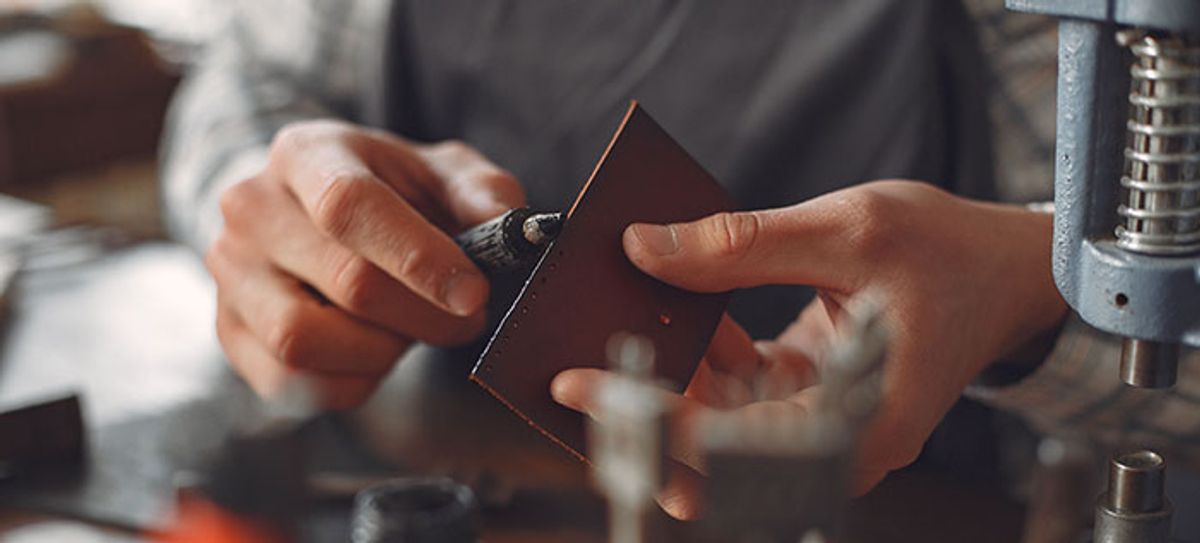
- The Human Element: Edge painting is not a one-step process. A truly premium edge requires 3 to 4 coats. A skilled craftsman must apply the base coat, send the piece through a climate-controlled drying room, manually sand the edge perfectly flat, and repeat the process until the edge forms a seamless, domed rubberized seal.
- Why Experience Matters: A machine can dispense paint, but it takes a seasoned worker with over 5 years of tactile experience to know exactly how much pressure to apply so the paint doesn't overflow onto the wallet's face, preventing peeling and cracking in the end-user's pocket.
4. Sourcing Decision Matrix for B2B Buyers
- Choose Full Grain If: You are building an EDC (Everyday Carry), heritage, or rugged outdoor brand where customers appreciate "patina" (the darkening and aging of leather over time), and your retail margins can absorb a 30% to 40% material cutting loss.
- Choose Top Grain If: You are designing corporate gifts, fashion-forward accessories, or minimalist wallets where flawless color consistency, scratch resistance, and aggressive OEM pricing are your primary goals.
FAQ for Procurement Teams
Q1: Will Top Grain leather develop a patina over time like Full Grain?
No. Because the outermost porous layer has been buffed away and sealed with a pigmented topcoat, Top Grain leather maintains its original color and texture for years. It does not absorb oils or darken over time, which is actually preferred by many high-fashion brands.
Q2: Can you automate the cutting of Full Grain leather?
While we utilize advanced CNC cutting machines, cutting high-end Full Grain leather still heavily relies on human expertise. An experienced operator must visually scan the hide and manually arrange the digital cutting map to dodge natural scars—a nuance AI and cameras still struggle to perfect without causing excessive waste.
Q3: Does Top Grain leather mean it is "fake" or "low quality"?
Absolutely not. Top Grain is 100% authentic cowhide. It simply refers to the mechanical processing of the surface. Many of the world's most famous luxury houses (especially those utilizing Saffiano or Epsom leathers) rely almost exclusively on Top Grain for their flagship structural handbags and wallets due to its durability and uniformity. Send your design drawings, annual volume and target FOB through our contact page and a production engineer will come back with the yield, finishing route and per-unit costing for the leather you have chosen.