Market Insights
How to Vet a Custom Wallet Manufacturer in China Without Getting Burned on Bulk
Published on Oct 14, 2026
The short answer
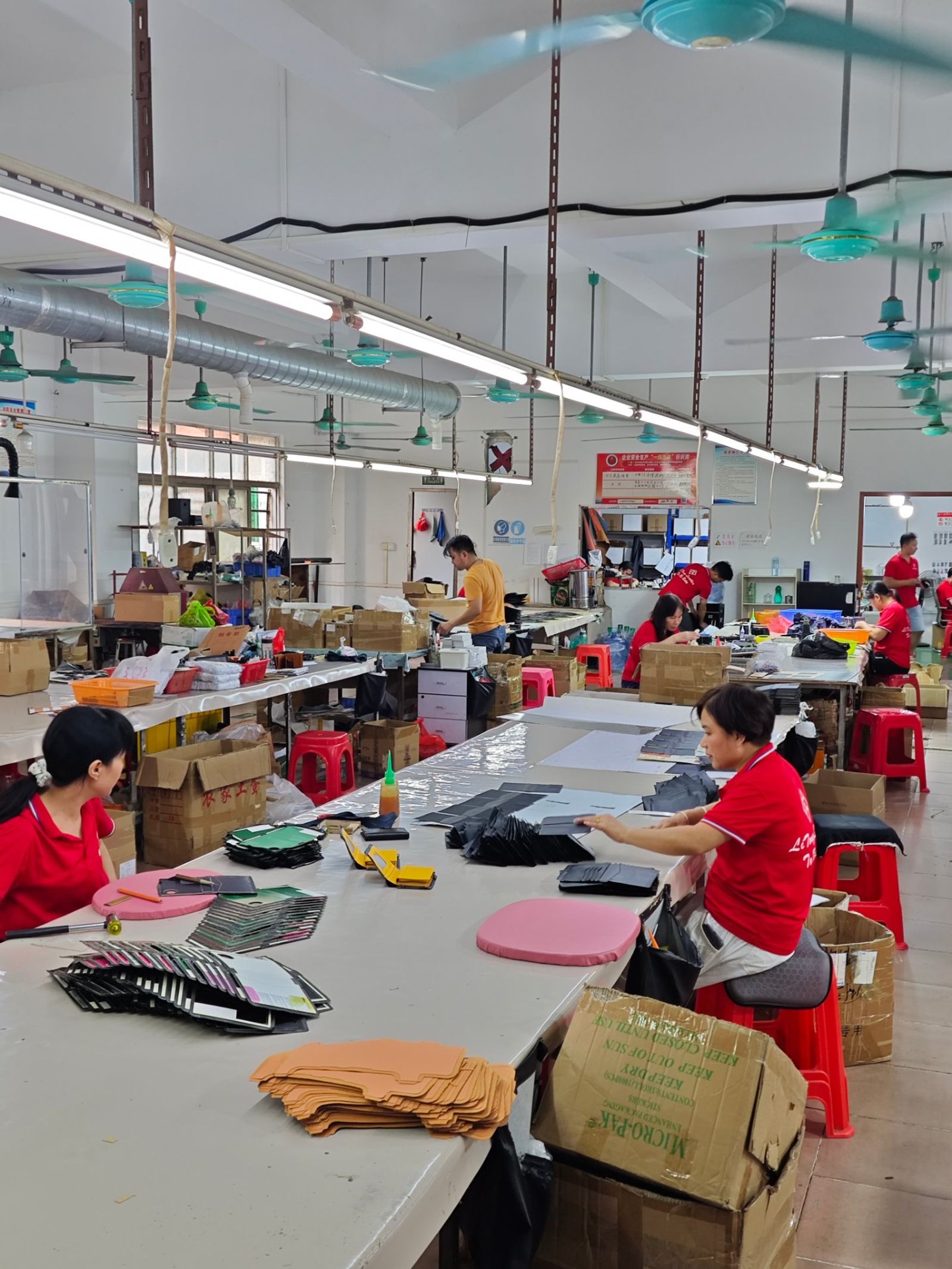
China's small leather goods supply chain concentrates in Guangdong, where cutting, edge finishing, hardware pressing and printing sit within a short drive of one another in Huadu's Shiling town and parts of Baiyun district. Factories that build backpacks and travel bags and also quote wallets generally subcontract the interior pocket work or the edge painting, and that is where most bulk complaints originate. Two documents separate a wallet factory from an assembler: the incoming material inspection log and the in-process check sheet, and both should be shown to you rather than described.
Where the wallet supply chain actually sits
Production of flat leather goods clusters tightly in Guangdong, and within Guangdong it clusters again. Shiling town in Huadu district and the surrounding Baiyun district hold the densest concentration of die-cutting, skiving, sewing, edge-paint and hardware assembly in the country. Hebei also produces small leather goods, but generally at a lower tier: thinner splits, glued rather than stitched interiors, and a narrower hardware catalogue. The distinction is not about prestige. A leather wallet needs die-cutters, a skiving machine, an edge-paint station and a hardware press, and a cluster means all four can be re-tooled at short notice when a spec changes mid-order.
- Ask which district the factory sits in, then ask which district its edge-painting and hardware-plating subcontractors sit in. Distance is a rough proxy for how quickly a spec change gets absorbed.
- A cluster address proves nothing on its own. Trading offices list Huadu addresses and place orders two provinces away, so ask for the address of the actual sewing floor and compare it to the shipping documents.
- If the factory is far from any cluster, ask how it handles a mid-production hardware change. The answer usually reveals whether it owns the press or sends the work out.
Buyer-side questions we field repeatedly are collected in the Market Insights archive.
Specialist or generalist: how to tell in one visit
A factory that runs totes, luggage and belts on the same floor will generally treat wallets as filler between larger orders. That is not automatically disqualifying, but it shows up in two predictable places: interior pocket construction and edge finishing, both of which are slow, hand-heavy operations that a bag line has little incentive to optimise.
- Ask what share of output is flat goods — wallets, card holders, passport covers — as opposed to bags. A specialist answers immediately; a generalist tends to describe capability instead.
- Ask to see the edge-paint station, not the sample room. It should be a dedicated bench with drying space, not a corner of a packing table.
- Ask whether interior pockets are cut, folded and stitched in-house or bought as a finished component. Bought-in pockets are consistent but leave you no route to change the pocket geometry.
- Ask how hardware is stored. Bagged by purchase order in labelled bins is normal; loose dome studs and eyelets sharing one open box is how a wrong finish ends up on part of a shipment.
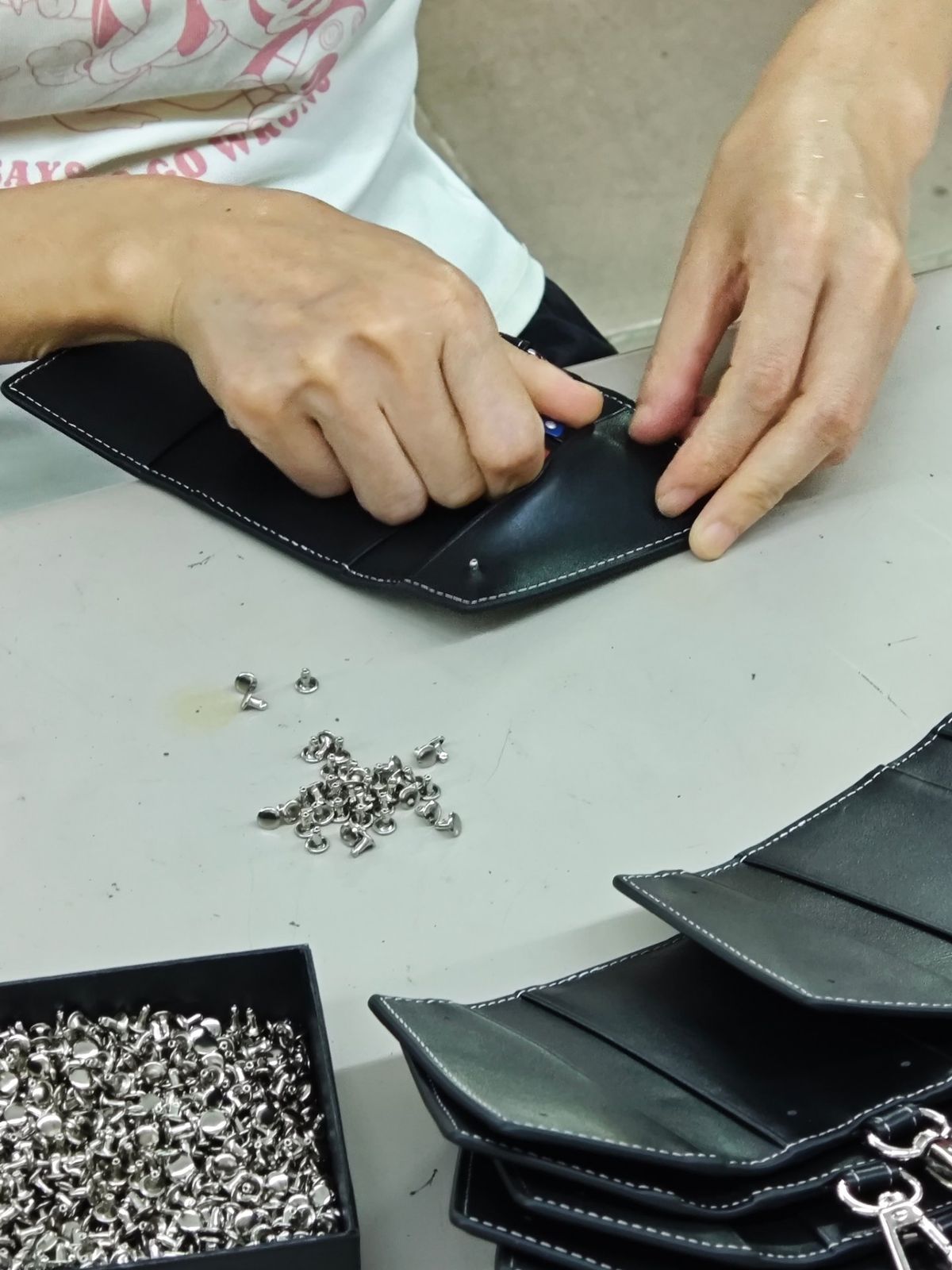
On the bench, an assembled wallet tends to look like this: pre-folded interiors with the closing seam already run, a shallow tray of dome studs and eyelets, and an operator pressing each stud through a punched hole by hand. The stud going in is not what you inspect. Look at the back of the stud and the leather immediately around the hole, which is where a rushed setting shows as a cracked plating or a stretched, shiny ring in the grain.
Sampling proves the sample room, not the line
A sample table holds one piece of each panel. A cutting bench holds a stack of them, and an operator picking from that stack is looking for the cleanest grain face and pushing the rest down the pile. This single difference explains most cases where a bulk shipment does not match an approved sample.
When you visit, do not look at the wallet handed to you. Look at these instead:
- The third or fourth piece down a stack, opened at the fold. Check whether the interior seam allowance holds a consistent width or wanders.
- Whether the lining is glued along its full length or spot-glued at the corners only. Full-length glue is faster and produces a stiff, ridged fold that customers notice.
- The cut edges of the lining before edge paint goes on. A fuzzy, ragged edge telegraphs through the paint within a season, and no amount of topcoat hides it.
- The reject bin during a live run. An empty one is a warning, not a compliment.
- The traveller card clipped to a bundle, if the line uses them. It tells you whether a bundle can be traced back to a cutter and a shift.
Reading the quality control paper trail
Every factory will tell you it inspects. The question is whether inspection produces a record you are allowed to see, and whether that record has a rejection rate on it.
- Incoming material: hide thickness measured at several points across a panel, colour checked against the approved swatch across dye lots, and visible grain defects flagged before cutting. Without this step, defects are discovered after the panels are already sewn.
- In-process: checks after the closing seam and before hardware setting, when a rework is still cheap. Hardware setting is the point of no return on a leather panel.
- Final: hardware security under a pull test, edge paint coverage at the fold, stitch run-out at the corners, and any RFID or lining specification tested on the finished piece rather than on the component.
- Ask for the last month's filled-in sheets, not a blank template. A template proves a system exists on paper; a filled sheet proves someone uses it.
Frequently asked questions
What actually determines the minimum order quantity for a custom wallet?
MOQ moves with three things: material, hardware and tooling. A stock cowhide, split or PU in a colour the factory already holds carries a lower floor than a custom-dyed tannage, and a catalogue stud or zip pull carries a lower floor than a die-cast logo plate that needs its own mould. A new embossing die, a printed lining or a custom box each add a setup that the factory will want spread across the run. Send a complete spec sheet — shell material, lining, hardware finish, logo method, packing — and the factory can quote a quantity against it rather than a generic number.
How long does sampling take, and how long does bulk production take?
Sampling time is set by the slowest input, not by the sewing. If the leather is in stock and the hardware is a catalogue item, the sample is mainly a scheduling question; if the hide has to be dyed to a reference colour and the logo plate needs a mould, the sample clock starts when those arrive, not when you approve the drawing. Bulk delivery follows the same logic: it depends on when approved materials land and where your order sits against existing line allocation. Ask for the approved sample to be signed, dated and kept as the reference piece, and ask in writing which materials are ordered against that signature.
How do I confirm the leather grade in a sample before committing to bulk?
Look at the back of the leather, not the face. A full-grain or top-grain hide shows a tight, fibrous reverse and a grain that moves with the surface when you press it; a split with a sprayed or embossed finish shows a flatter, more uniform reverse and a pattern that stays put under pressure. Fold the wallet along a seam and examine the crease under raking light — surface-corrected leather tends to craze at the fold, while a full grain creases without breaking the finish. Where the shell is lined and glued, ask for a cut sample so you can check thickness at several points across the panel. Indoor lighting is not a reliable colour test; view the same piece outdoors before signing.
Before you commission the first sample
Ask the factory to return your spec sheet corrected in their own words — shell, lining, thread, hardware finish, edge treatment, packing — and settle those corrections before a single panel is cut. A supplier that argues about details at that stage is giving you useful information early, while it is still cheap. When you are ready to see how a cut-and-sew floor is laid out before your first visit, start with the OEM/ODM process and the factory background pages.