Material Research
Why a Crocodile Skin Wallet Is Cut From the Belly — And What That Means for Your Order
Published on Oct 10, 2026
The short answer
A crocodile skin wallet is cut almost entirely from the belly, the only region flat and flexible enough to fold without the scales lifting along their edges. Because the back, tail, and flanks are either heavily tiled or irregular in outline, a hide that looks generous on the bench yields only a small number of wallet panels, and the remainder becomes trim waste. Crocodile-embossed cowhide removes that yield constraint entirely, and the two materials separate cleanly at the cutting table on scale pattern, fold behaviour, and the flesh side.
Why the belly carries the price
On a crocodile hide, scale size and flexibility move together. Belly scales sit in even rows as wide, flat rectangles with almost no overlap between one row and the next, so a fold passes through them without forcing one scale against its neighbour.
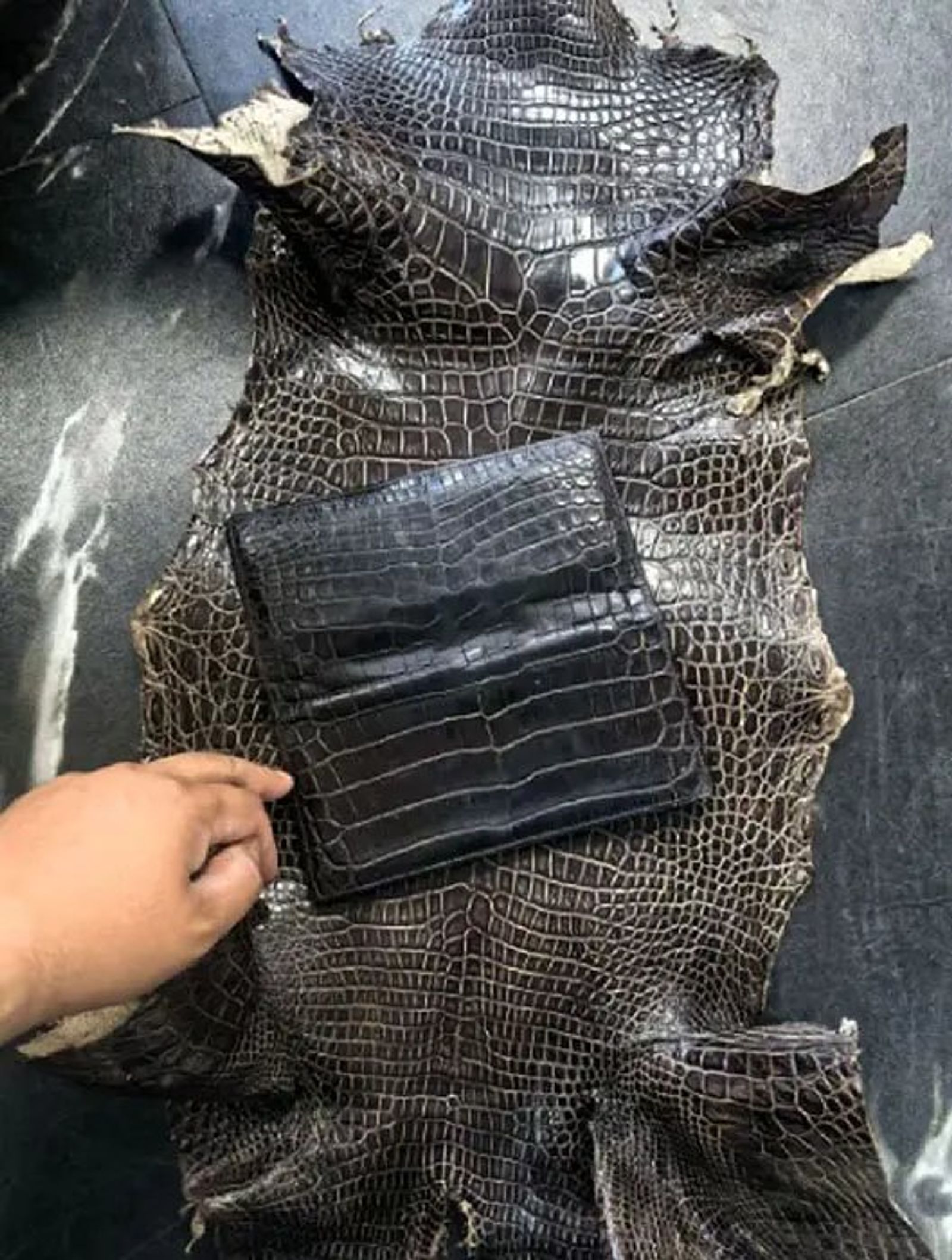
Spread a hide on the bench and the transition is visible without any instrument. The spine line holds the smallest and thickest scales; move outward toward the belly and they open into broad rectangles. A wallet placed on top of the skin in the same frame shows its scale rows running horizontally across the flap, and that orientation comes from where the panel was cut, not from styling.
- Belly: rectangular scales, even rows, folds to a soft crease.
- Hornback (back): domed, overlapping tiles; bending them lifts the tile edges.
- Tail and hip: smaller and harder again, rarely used for a wallet face.
- Natural outline: skins arrive with uneven edges, leg openings, and occasional scars, all of it deducted from usable area.
This is the first reason a genuine crocodile wallet costs what it costs. It has less to do with the animal being uncommon than with how much of the hide a wallet can actually consume.
Cutting for yield is where an order begins. The cutter works around the spine, around the leg openings, and around any healed scar, then sorts what remains into panels. On a small hide that arithmetic is tight, which is why a crocodile wallet programme is usually planned around a settled number of panels per skin rather than an open-ended run.
What to check on a hide before you commit
Most of the material questions a buyer has can be answered in ten minutes at a bench, without a laboratory.
- Press a thumb into the scale field and release. Belly scales spring back; hornback tiles stay rigid under the same pressure.
- Fold a section, not a finished sample. Genuine crocodile creases along the belly and lifts between the tiles on the back.
- Look at the scale seams. On real skin they follow the animal's growth — rows widen gradually, and no two sections repeat identically.
- Turn the hide over. The flesh side of genuine crocodile is dense and firm, with the scale layout faintly mirrored beneath.
- On embossed cowhide, the pattern repeats mechanically, and the flesh side reads as ordinary cowhide fibre.
Those five checks cover the distance between a genuine belly cut and a printed or embossed surface. They also explain why a swatch alone is a weak basis for a decision: a swatch shows the surface, while the fold and the flesh side show the construction underneath. Buyers comparing panels across suppliers will find more of these bench-level tests in our crocodile and exotic leather material research.
Crocodile-embossed cowhide: where it makes sense
Cowhide finished with a crocodile emboss does not pretend to be a belly cut, and for most wallet programmes that is not the point. It offers something genuine skin cannot: a large, predictable panel with an even temper from edge to edge.
- Width: a cowhide side cuts long wallets, passport holders, and briefcase panels with far fewer joins.
- Consistency: colour, temper, and pattern run evenly across the side, so a large run stays visually uniform.
- Cost structure: material cost per panel is a fraction of a belly cut, which is why embossed cowhide dominates volume wallet programmes.
- The trade-off: the pattern is a surface effect. Repeated folding softens the emboss, and edge paint has to be built slightly heavier to cover the cut edge cleanly.
One practical note on finishing. Hot foil stamping sits on top of the emboss and can flatten it under heat and pressure, so stamp depth is worth testing on scrap panels before a run starts. The same logic applies to full-grain work without an emboss, where the grain is already open and a deep stamp can close it permanently — see how that plays out on a full-grain cow leather bifold wallet.
What actually moves the quote
A handful of variables decide what a crocodile wallet programme costs, and none of them is a figure a supplier can quote from a single email.
- Skin size class and usable belly area — a larger skin is not automatically cheaper per panel if the ratio of belly to tile is poor.
- Hardware — a stock zip pull and a custom die-cast plate sit at opposite ends of the range, and tooling belongs to the second case.
- Quantity tier, which is tied to how panels nest across each skin.
- Construction — one edge-paint pass versus two with a sand between them, lined versus unlined interiors, and whether an RFID layer is laminated in.
This is also why quotes for exotic leather arrive more slowly than quotes for embossed cowhide. Before a figure means anything, a supplier needs panel dimensions, the hardware list, the colour reference, and the volume you are planning against. Our OEM/ODM services page sets out what that brief normally contains.
Frequently asked questions
What is the minimum order quantity for a crocodile skin wallet?
MOQ on genuine crocodile is driven by material availability rather than by a factory policy. Belly cuts are limited by the size of the skins a tannery can supply, so the practical floor is usually set by how many panels one batch of skins yields in your dimensions. Hardware is a second lever: a custom metal plate or an engraved clasp raises the floor because of tooling, while a stock pull does not. Send your panel sizes, hardware list, and planned annual volume, and the MOQ becomes a calculated figure rather than a guess.
How long does sampling and bulk production take?
Sampling time depends on whether the skins are in stock, whether the hardware is catalogued or needs a new die, and whether the colour is matched from an existing reference or built from scratch. Bulk timing follows the skin purchase, the cutting yield, and the drying time on edge paint, which cannot be shortened without a visible result at the fold. Give a factory a full spec sheet, a colour reference, and confirmed panel dimensions, and it can give you a schedule it is able to hold.
How do we control colour difference between the swatch and the bulk?
Check colour under a defined light source, not in the corner of an office. Genuine crocodile carries natural variation from scale to scale, so expect batch sorting rather than one uniform tone across a large order. Edge paint and the leather face also shift against each other under different lighting, so both should be reviewed together. Approve a physical reference panel taken from the actual production skins, keep it, and hold the bulk against it.
Next step
A wallet programme in genuine crocodile starts with the panel drawing, not the price. Send the dimensions, the hardware list, and a colour reference, and a panel can be cut from an actual skin so you see the scale layout before anything is committed. If the volume side of your range runs on embossed or full-grain cowhide, the same brief applies and the schedule tightens considerably — contact us with the spec and we will work from there.