Design & Craftsmanship
The Manufacturer's Guide to Custom Leather Knife Sheaths: Materials, Wet Molding, and OEM Scaling
Published on Oct 27, 2026
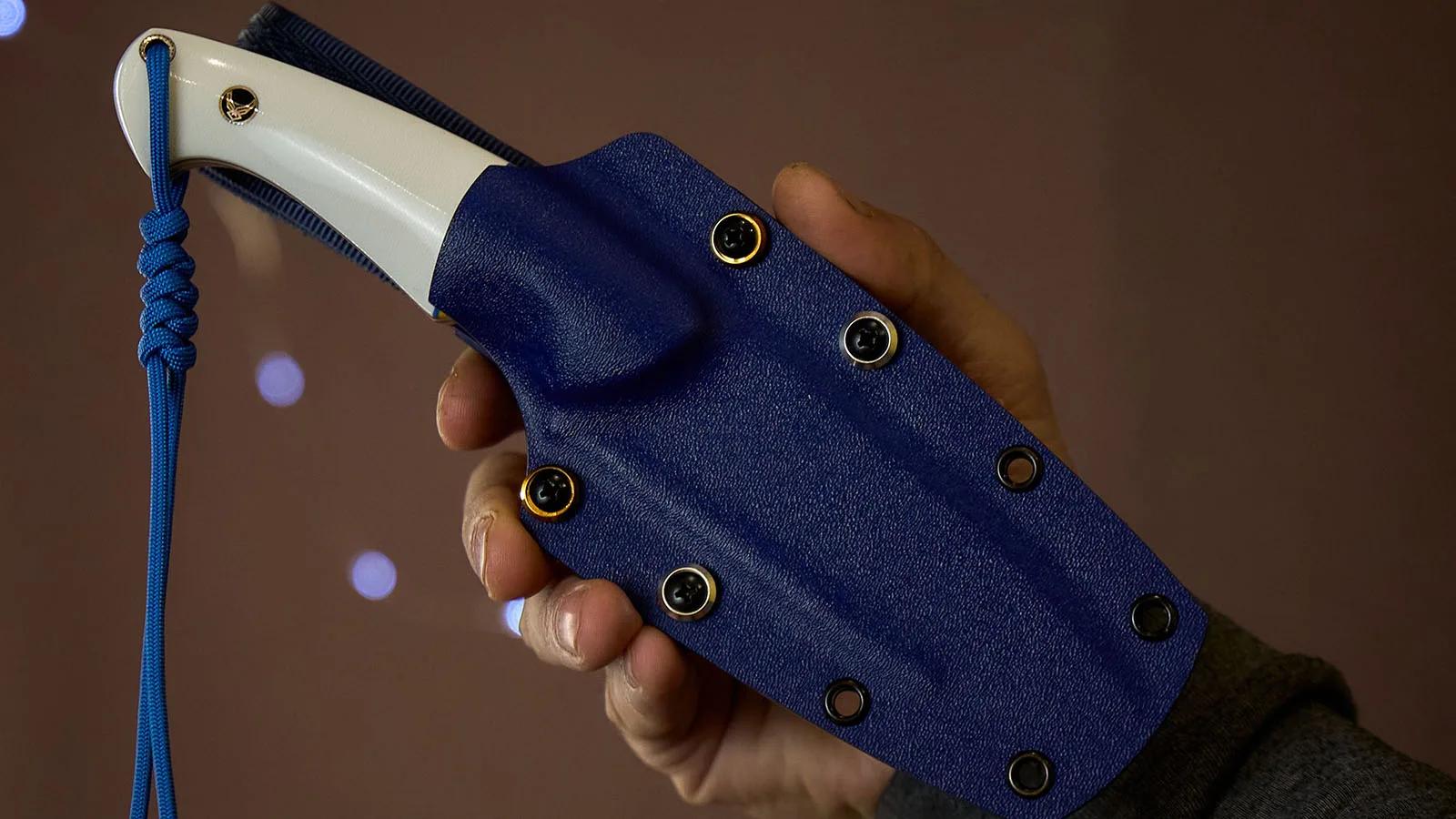
Knife makers spend weeks perfecting blade geometry and heat treatments, yet often compromise the final product with substandard sheaths. For B2B buyers and outdoor brands, sourcing custom leather knife sheaths requires balancing structural rigidity, chemical safety, and scalable production. A poorly specified sheath leads to blade dulling, retention failure, and end-user injury.
Material Selection: The Vegetable-Tanned Mandate
Chrome-tanned leather is strictly unsuitable for knife sheaths. The residual chromium salts left over from the tanning process react with high-carbon steel, causing accelerated corrosion on the blade. Furthermore, chrome-tanned hides lack the rigidity required for structural edge protection.
B2B procurement must specify heavy-weight (8oz - 10oz) full-grain vegetable-tanned leather for all custom made knife sheaths. Vegetable tanning utilizes natural tannins, providing three critical manufacturing advantages:
- Rigidity: Maintains its exact shape under structural stress, preventing the sheath from collapsing when empty.
- Malleability: Accepts extreme moisture for high-pressure wet molding, allowing for a precise friction-fit.
- Chemical Neutrality: Contains no corrosive salts, protecting expensive carbon and Damascus steel edges from oxidation.
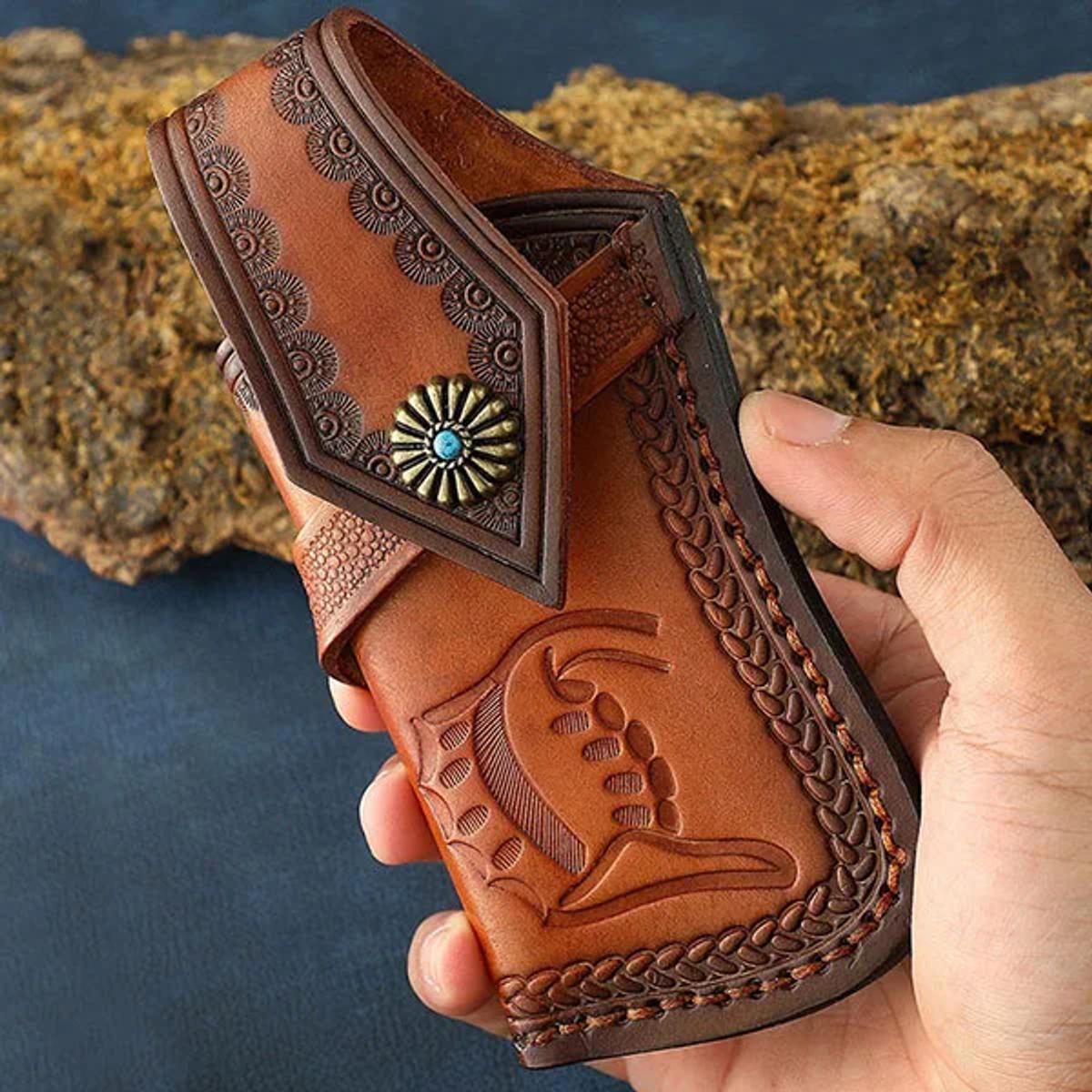
Precision Manufacturing: Wet Molding and Structural Defense
A premium knife sheath relies on exact physical tolerances. Standard flat-stitched patterns fail to secure folding knives or complex fixed blades safely. Factory-level OEM production utilizes precision 3D wooden or resin molds to execute wet molding. This process forces the leather to wrap tightly around the specific contours of the knife, creating a secure friction fit that eliminates the need for secondary retention straps or synthetic plastic inserts.
To prevent blade cut-through during insertion, the welt—a thick strip of leather sandwiched between the main panels along the cutting edge—must be oversized and secured with heavy-duty bonded nylon thread. High-stress impact points require solid brass or copper rivet reinforcement. For clients requiring a custom leather knife sheath for belt carry, the rear loop integration must be skived and double-stitched to withstand continuous dynamic load in outdoor environments.
Scaling Handmade Leather Knife Sheath Designs
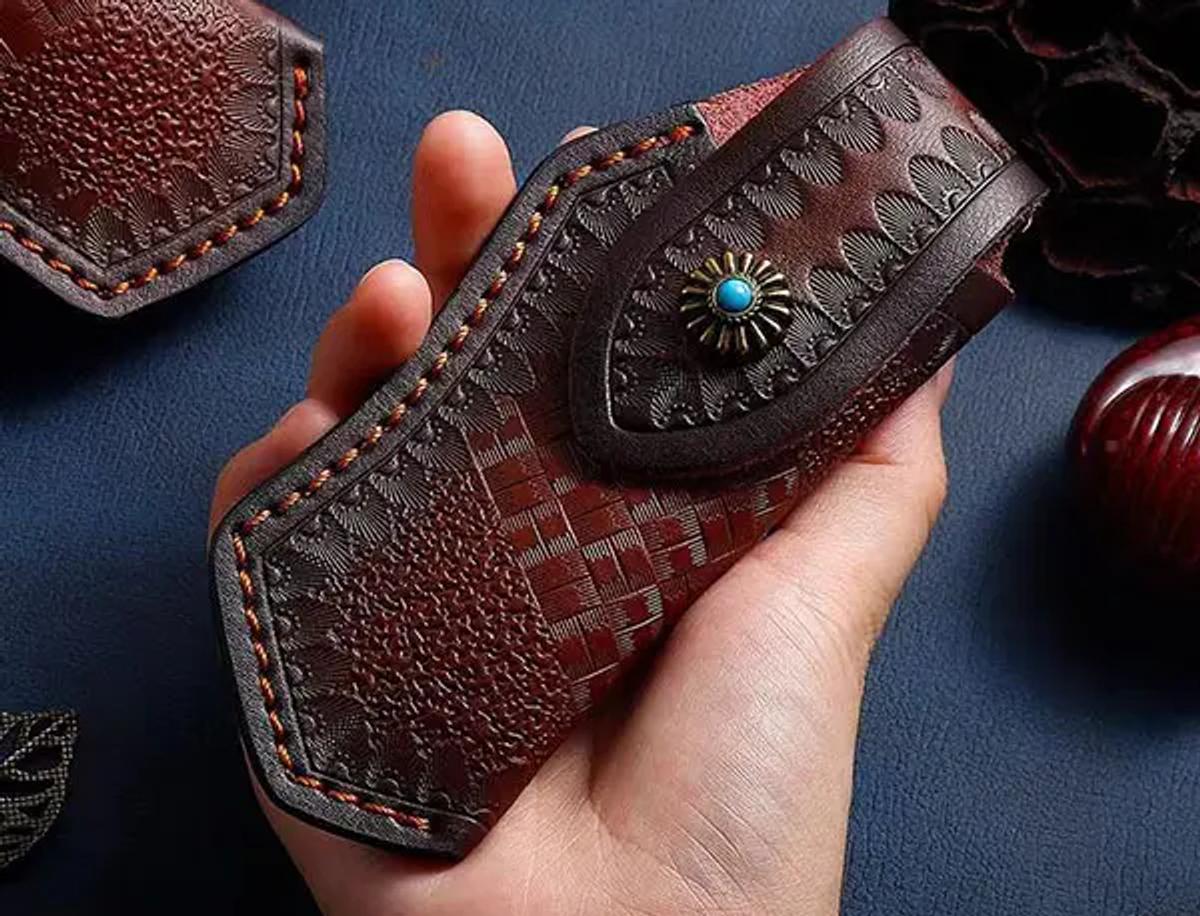
Translating handmade leather knife sheath designs into bulk OEM production is the primary bottleneck for growing EDC brands. Artisanal prototypes often feature intricate hand-tooled aesthetics or unique basketweave patterns that are difficult for smaller workshops to standardize at volume.
Many outdoor brands mistakenly assume that intricate basketweave or floral patterns are achieved via laser engraving. In reality, lasers simply burn the surface, destroying the leather's structural integrity and leaving a flat, charred mark.
True 3D textural depth requires industrial Heated Hydraulic Embossing. For OEM scale, we translate traditional hand-tooled designs into CNC-machined solid brass plates. The full-grain vegetable-tanned leather is precisely cased (dampened), and the heated brass plate is applied using a 50-ton hydraulic press. This extreme pressure permanently compresses the leather fibers into a high-relief 3D pattern. Finally, an antiquing stain is hand-rubbed over the surface, settling into the recessed grooves to create a rich, high-contrast vintage patina that laser machines cannot replicate.
Choosing the Right Manufacturing Partner: Why SLG Factories Win
When sourcing custom leather knife sheaths, choosing the wrong type of manufacturer guarantees quality control disasters and delayed lead times. Many outdoor brands make the mistake of relying on their knife/metal manufacturers for leatherwork. While these factories excel in metallurgy, they typically treat leather as an afterthought, resulting in crude, flat-stitched sheaths with unfinished edges.
Conversely, large bag and luggage factories are equally unsuitable. They are accustomed to working with soft, chrome-tanned leathers, fabric linings, and broad dimensional tolerances. They simply lack the micro-precision machinery required for rigid 3D wet molding.
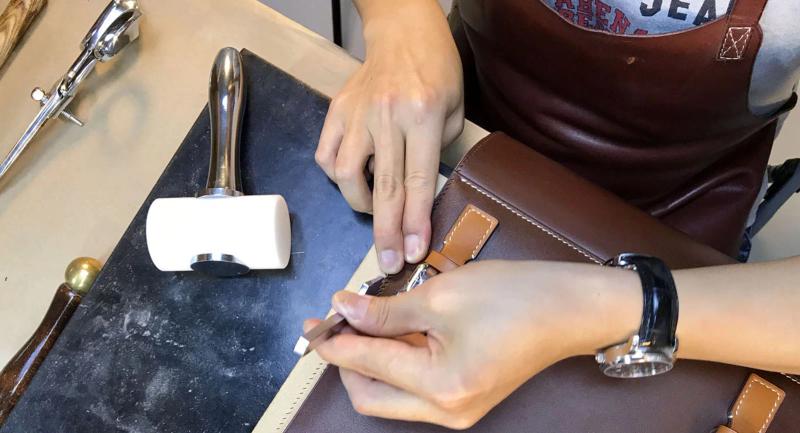
The only correct choice is a specialized Small Leather Goods (SLG) manufacturer. SLG factories are uniquely equipped with heavy-duty stitching machinery, precision edge-finishing tools, and the strict millimeter-level tolerance control required for wallets and cardholders. This exact micro-precision is what guarantees your folding knife or EDC tool will have a perfect friction-fit draw, every single time.
Technical FAQ for B2B Procurement
Q: What is the initial setup cost for custom sheaths for knives?
A: One of the biggest advantages of manufacturing leather goods is the exceptionally low tooling cost. Unlike plastic or metal production, creating the physical templates and molds for leather wet molding typically costs as little as $30 to $50. Furthermore, for standard OEM bulk orders, we often waive these initial setup fees entirely. This allows knife brands to prototype and scale new designs with practically zero tooling risk.
Q: Can you manufacture a custom leather knife sheath for belt carry in specific orientations?
A: Yes. Belt loops can be engineered for vertical, horizontal (scout carry), or 45-degree angled configurations. The exact orientation and belt width tolerance (typically 1.5 to 2 inches) must be specified during the CAD prototyping phase to ensure proper center-of-gravity balancing.
Q: How do you match the finish of a personalized leather knife sheath across a large OEM order?
A: Consistency in color and texture is achieved by sourcing hides from a single tannery batch and utilizing automated drum-dyeing processes. We apply specialized top-coat acrylic sealants to lock in the dye, prevent color bleeding onto clothing, and provide uniform water resistance across the entire production run.