Material Research
How to Tell Real Leather from Faux Leather: A B2B Buyer’s Guide to Field Tests & Factory IQC
Lab Verification & Testing Scope:
Last Verified: November 2026 | Data Source: Orviabag Baiyun Factory IQC Laboratory (aggregated from 428 incoming hide and synthetic roll inspections, Q1–Q4 2026) | Testing Standards: Executed under ISO 9001:2015 Incoming Quality Control procedures per ISO 17131, ISO 3376, and ISO 5402.
How do you tell real leather from faux leather?
Inspect the unsealed cross-section and pore structure under 30x magnification: real leather exhibits irregular hair follicles and an intertwined corium fiber base, absorbing a water drop within 8–15 seconds. Faux leather (PU/PVC) displays uniform machine-embossed pores, a woven textile backing, and zero water absorption (per ISO 17131:2012).
For B2B brand buyers and sourcing managers ordering 1,000+ wallets or cardholders, misidentifying heavily coated split hides or polyurethane (faux leather) leads to customs tariff misclassifications (HS Code 4202.31 vs. 4202.32), peeling claims within 18 months, and legal penalties under EU and US labeling laws.
Below are the exact sample-room field checks and laboratory Incoming Quality Control (IQC) benchmarks our Guangzhou Baiyun production team uses to verify every material batch before cutting.
How to Tell Leather from Fake Leather in 30 Seconds? (Sample Room Field Checks)
1. What Does the Unsealed Cross-Section Edge Reveal?
A raw cross-section is the single most reliable visual indicator: real leather transitions from a tight structural dermis into a fibrous corium layer, whereas faux leather reveals a top polymer film laminated onto a woven or non-woven fabric backing.
On finished wallets and bags, edges are typically sealed with polyurethane edge paint or folded over (turned edges). To inspect the cross-section without cutting the sample:
- Check the unsealed interior of card slots, hidden cash compartments, or zipper tape gussets.
- Under a 10x–30x loupe, Tier-1 natural cowhide shows three-dimensional, randomly intertwined collagen fiber bundles.
- Standard polyurethane (PU) or polyvinyl chloride (PVC) faux leather shows a clean lamination line separating the foamed plastic layer from a polyester knit or cotton textile grid.
- How to distinguish Microfiber Faux Leather: High-grade microfiber uses a needle-punched polyamide base that closely mimics natural suede fibers. Pull a single loose strand from an unsealed interior seam with tweezers: synthetic microfiber strands have uniform extruded thickness, whereas natural corium fibers vary in diameter and branch irregularly.
2. What Do Pore Patterns Look Like Under a 30x Loupe?
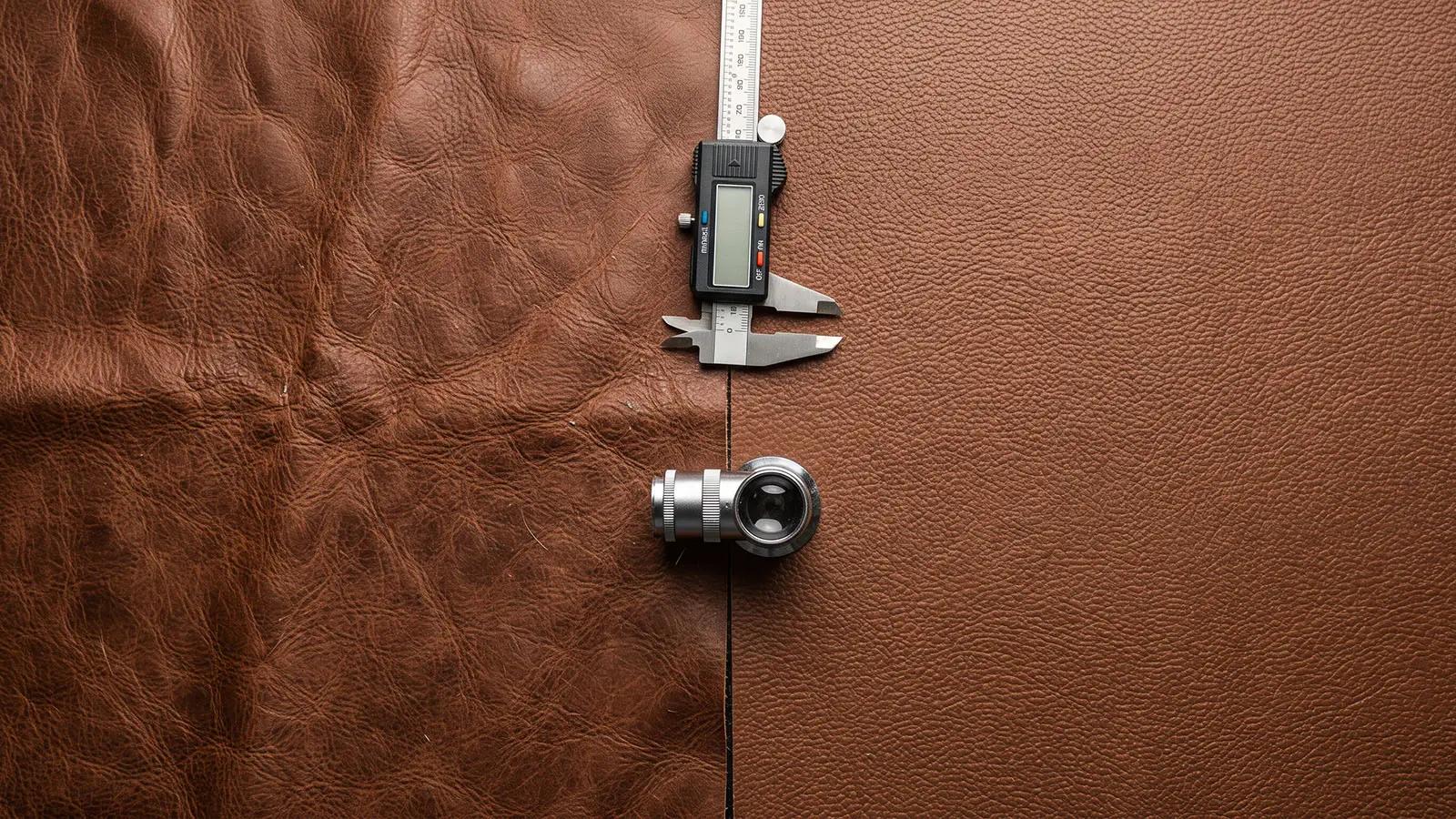
Natural Full-Grain and Top-Grain leather displays asymmetrical, variably spaced hair follicles that enter the hide at an angle, while faux leather features repetitive, uniform depth craters stamped by a steel embossing roller.
When our IQC inspectors evaluate incoming hides against synthetic swatches:
- Full-Grain & Top-Grain Cowhide: Follicle clusters vary in density between the tighter backbone (croupon) and looser belly areas. Even on pebble-embossed Corrected-Grain leather (such as Saffiano or Litchi patterns), examining the valleys between embossed grains under 30x magnification reveals microscopic dermal pores.
- Embossed Faux Leather: Because synthetic rolls are pressed continuously by engraved cylinders, the exact same pore pattern or grain intersection repeats every 30 cm to 60 cm along the roll. The bottom of each artificial pore is completely closed and smooth.
3. How Fast Does Real Leather Absorb Water Compared to Faux Leather?
Under standard laboratory conditioning (23°C ± 2°C and 50% relative humidity per ISO 2419), unfinished Full-Grain or semi-aniline Top-Grain real leather absorbs a 0.05 ml drop of distilled water within 8 to 15 seconds, while faux leather holds the droplet on the surface indefinitely.
| Surface Material Type | 0.05 ml Water Drop Reaction (at 15 Seconds) | 0.05 ml Water Drop Reaction (at 120 Seconds) | Surface Recovery After Drying |
|---|---|---|---|
| Full-Grain Leather (Uncoated) | Complete absorption in 4–8 seconds; darkens immediately. | Moisture diffuses into surrounding dermal collagen fibers. | Returns to original color in 15–20 mins; zero residue. |
| Top-Grain Leather (Semi-Aniline) | Contact angle flattens; partial absorption in 10–15 seconds. | 60%–80% absorbed through natural pore channels. | Returns to original state; slight temporary darkening. |
| Split Leather ("Genuine Leather") | Droplet beads up initially due to thick top PU film. | Minimal absorption; slight darkening only along flex creases. | Wipes off; requires cross-section check to verify base. |
| PU / PVC / Microfiber Faux Leather | PU / PVC / Microfiber Faux Leather | Zero absorption; droplet remains completely intact. | Wipes dry instantly with zero color change. |
4. Why Should B2B Buyers Avoid the "Fire Burn Test" on Finished Samples?
The internet "lighter burn test" is scientifically invalid for finished leather goods because modern REACH-compliant faux leather frequently contains flame-retardant additives, while real leather wallets carry flammable wax, finishes, and polyurethane edge coatings.
Holding an open flame to a finished wallet edge for 3–5 seconds does not test the base hide. Instead, you ignite the surface topcoat or edge paint, producing an acrid plastic smell even on a 100% Full-Grain wallet. Conversely, flame-retarded contract faux leather self-extinguishes without dripping, fooling buyers into thinking it is natural hide. Never use open flames for quality verification.
Real Leather vs. Faux Leather: What Are the Exact Technical Differences?
Tier-1 real leather retains the hide's structural dermis—delivering $\ge 18\text{ N/mm}^2$ tensile strength and over 50,000 flex cycles—whereas faux leather is a synthetic polymer sheet cast onto a textile or microfiber substrate.
In B2B manufacturing, choosing between real hide and faux leather is a trade-off between structural longevity and cutting efficiency. Natural hides contain irregular contours, neck wrinkles, and brand marks, resulting in higher cutting waste on automated CNC nesting tables. Synthetic rolls arrive in uniform 1.37-meter widths, allowing near-zero waste nesting.
To align with our 2026 Baiyun Factory Laboratory Comparison Matrix, here is how Tier-1 real leathers compare directly against commercial faux leather grades:
| Material Grade | Supply Format & Tier | Material Yield Rate (Cutting Waste) | Tensile Strength (ISO 3376) | Flexing Endurance (ISO 5402) | Hydrolysis & Service Life |
|---|---|---|---|---|---|
| 1. Full-Grain Leather | Tier 1 (Upper Hide) | 60% – 70% (30%–40% cutting waste) | ≥ 22 N/mm² | > 80,000 cycles (No cracking) | 10 – 25+ years (develops patina; never hydrolyzes) |
| 2. Top-Grain Leather | Tier 1 (Upper Hide) | 85% – 90% (10%–15% cutting waste) | 18 – 22 N/mm² | > 50,000 cycles (No cracking) | 5 – 10+ years (stable finish; resists pocket friction) |
| 3. Split Leather ("Genuine") | Tier 2 (Bottom Hide) | 90% – 95% (5%–10% cutting waste) | 8 – 12 N/mm² | < 15,000 cycles (PU film delaminates) | 1 – 2 years (top film cracks at stress points) |
| 4. Microfiber Faux Leather | Synthetic Roll (1.37m wide) | 92% – 95% (5%–8% roll waste) | 16 – 24 N/mm² | > 80,000 cycles (No cracking) | 5 – 8 years (polyether PU resists tropical humidity) |
| 5. Standard PU Faux Leather | Synthetic Roll (1.37m wide) | 95%+ (<5% roll waste) | 8 – 14 N/mm² | 15,000 – 25,000 cycles | 1.5 – 3 years (peels due to ester hydrolysis) |
| 6. PVC Faux Leather | Synthetic Roll (1.37m wide) | 95%+ (<5% roll waste) | 6 – 10 N/mm² | < 10,000 cycles (Stiffens and cracks) | 1 – 2 years (plasticizer migration causes brittleness) |
Data Note: Compiled from Orviabag Baiyun Factory IQC laboratory records across 428 incoming production lots (Q1–Q4 2026).
How to Determine Real Leather in Bulk B2B Production? (Factory IQC Protocol)
To determine real leather across bulk orders of 500 to 50,000 units, manufacturers rely on ISO 17131 stereomicroscopy, ISO 3376 tensile testing, and Mitutoyo thickness gauging across hide zones rather than visual spot checks.
Approving a golden prototype does not guarantee bulk consistency if your supplier lacks a standardized incoming inspection gate. Unverified workshops frequently substitute Top-Grain cowhide with heavily coated Split Leather or microfiber on interior wallet panels (such as card dividers and cash linings) to shave $0.80–$1.50 off the unit BOM cost.
Under our ISO 9001:2015 quality management workflow, every incoming leather delivery at our Baiyun facility undergoes a three-stage IQC lockdown:
- Swatches & Stereomicroscope Verification (ISO 17131:2012):Our IQC technicians punch a $10\text{ cm}^2$ test swatch from the shoulder and belly of every 10th hide in a lot. Using a 40x stereomicroscope, we verify the intact dermal fiber network and measure the surface coating ratio.
- Tensile & Bally Flex Testing (ISO 3376 & ISO 5402):Dumbbell-shaped specimens are die-cut from incoming hides and clamped into a universal tensile machine to verify they meet the ≥ 18 N/mm² threshold for Top-Grain or ≥ 22 N/mm² for Full-Grain leather before mass cutting begins. Simultaneously, Bally flexometers cycle swatches to 50,000+ bends to ensure edge coatings and grain finishes do not micro-crack.
- Zone Thickness & Rub Fastness (ISO 2589 & ISO 11640):Before skiving leather down to 0.5 mm for folded wallet card slots, inspectors verify hide uniformity using a 0.01 mm digital Mitutoyo thickness gauge and run Martindale dry/wet rub tests so dark dyes never bleed onto a user's clothing.
How to Tell Genuine Leather from Coated Split or Bonded Leather?
You can tell true Tier-1 leather from inferior "Genuine Leather" or Bonded Leather by measuring coating thickness and tensile load: under European standard BS EN 15987, any hide with a plastic surface coating exceeding 0.15 mm—or exceeding one-third of total thickness—cannot legally be labeled as pure leather.
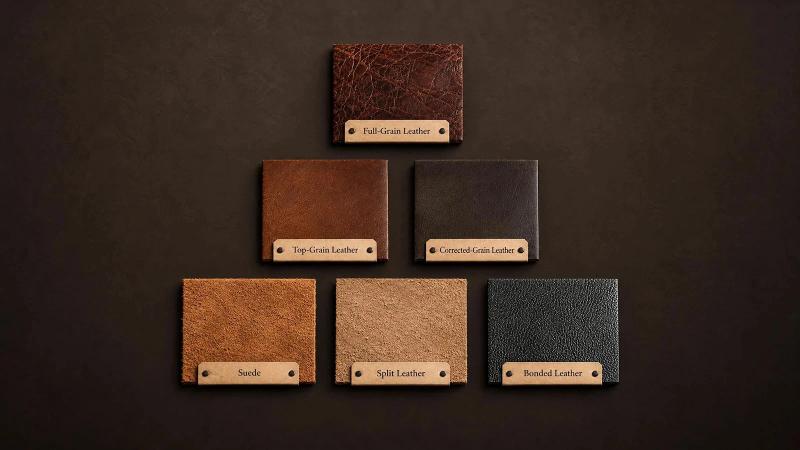
One of the costliest mistakes B2B buyers make when researching how to tell genuine leather is assuming the word "Genuine" indicates high quality. In commercial grading, "Genuine Leather" almost always refers to Tier-2 Split Leather (the weaker bottom hide layer left after the top grain is split off, sprayed with thick polyurethane and embossed with artificial pores) or Tier-3 Bonded Leather (floor scrap fibers shredded and glued onto a synthetic backing roll, yielding < 4N/mm² tensile strength and failing under 3,000 flex cycles).
- How to spot Coated Split Leather: Fold the swatch tightly grain-side in. Natural Top-Grain leather forms soft, tight curves. Heavily coated Split Leather forms sharp, angular pipe creases ("orange-peel wrinkling") because the top polyurethane film detaches slightly from the loose bottom suede fibers.
- How to spot Bonded Leather: Inspect the backing and tensile tear. Because Bonded Leather is supplied in synthetic rolls with a 95%+ yield rate, its cross-section looks like compressed paper pulp coated in plastic paint and tears easily by hand.
For a complete breakdown of all 6 commercial leather tiers, yield rates, and OEM cost structures, read our companion engineering guides:
- The Genuine Leather Trap: Why Split and Bonded Leather Quietly Inflate Your Landed Cost
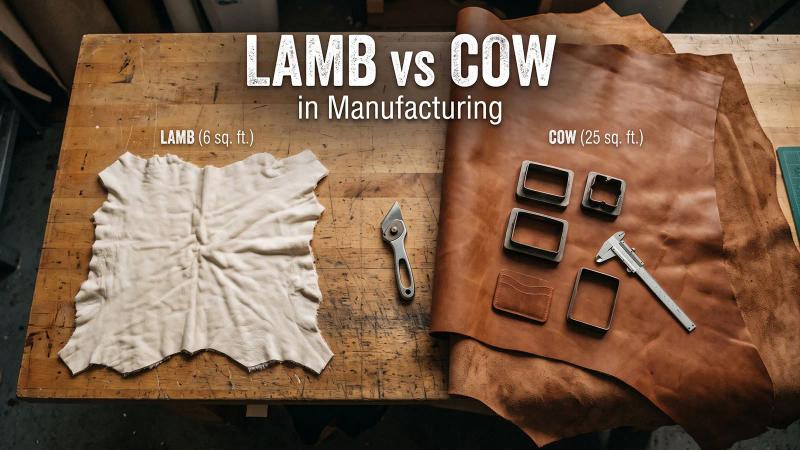
- Lambskin vs. Cowhide Leather: Material Yield, Durability, and 2026 OEM Costs
How Does Material Choice Impact Carton Weight and Freight Costs?
Switching between real cowhide and PU faux leather alters your shipment's gross-to-net weight ratio by 12% to 18%, which directly impacts air cargo chargeable weight and container volume planning.
Because Tier-1 cowhide has a higher fiber density (750–950 GSM at 1.2 mm thickness) than foamed PU faux leather (550–680 GSM), a master carton of 160 bifold wallets in real leather weighs roughly 2.1 kg to 2.8 kg more than the identical order in synthetic PU.
Before locking in your freight quotes, run your SKU specs through our B2B logistics calculators:
- Gross vs. Net Weight Calculator — Calculate exact N.W., G.W., master carton tare, and Express/Air DIM chargeable weight thresholds.
- Wallet & Card Holder Volume & Container Calculator — Estimate master carton dimensions (with +0.1 cm polybag or +0.5 cm retail gift box allowances) and 20GP/40HQ container utilization.
Frequently Asked Questions (FAQ)
1. Does real leather smell different from faux leather in bulk packaging?
Yes. When unpacking a master carton sealed for 15–30 days in ocean transit, real leather releases an organic, fatliquor and tannin aroma. Standard PU and PVC faux leather emits a volatile organic compound (VOC) solvent smell, while high-grade solvent-free microfiber is nearly odorless.
2. Is vegan leather the same thing as faux leather?
In commercial manufacturing, yes. "Vegan leather" is a retail marketing term for synthetic faux leather—primarily polyurethane (PU), PVC, or polyamide microfiber. Bio-based sheets (such as cactus, apple, or mycelium alternatives) still rely on a 35% to 65% polyurethane resin binder and a woven fabric backing to pass basic ISO 3376 tensile tests.
3. Can faux leather pass the same ISO 5402 flex tests as real leather?
Standard knitted-back PU faux leather cannot match Tier-1 cowhide; it typically cracks between 15,000 and 25,000 flex cycles and peels within 1.5–3 years due to hydrolysis. However, premium polyether-based microfiber faux leather can exceed 80,000 flex cycles (matching Full-Grain leather's mechanical flex life), though it never develops a natural patina.
4. How can I verify my OEM factory is using Top-Grain leather before paying the balance?
Specify the exact material tier and test metrics in your Purchase Order (e.g., "Tier-1 Top-Grain Cowhide per BS EN 15987, coating thickness ≤ 0.15 mm, Tensile Strength ≥ 18 N/mm² per ISO 3376"). Require the supplier to leave one unsealed raw edge inside the inner card slot or include three uncut production-lot swatches with the pre-shipment inspection (PSI) report.
Need Verified Leather Swatches or an OEM Quote?
Whether your next collection calls for Tier-1 Full-Grain cowhide or high-yield microfiber faux leather, our Baiyun District, Guangzhou factory (operating under ISO 9001:2015 quality control and BSCI social compliance) provides physical swatch kits with lab test sheets before sample development. Request a Custom OEM Quote & Swatch Kit →